|
|
| |
|
|
| |
|
|
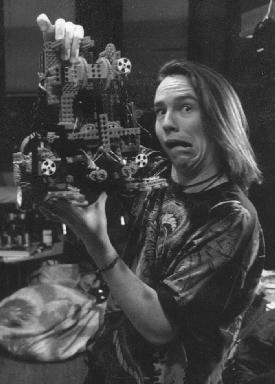
Colin Bulthaup has spent the past 5 years designing and building
various different kinds of robots. He is currently working towards
a Masters in Electrical Engineering with a strong emphasis on
ElectroMechanical integration. As a freshman he participated in
the 6.270 Autonomous Robotics competition and built the highest
scoring robot of the contest. He went on to teach a number of
courses on Autonomous Robotics at MIT and neighborhood highschools.
More recently, Colin has won the Sterling Engine design competition,
the 2.007 Robotics design competition, and the International Design
Competition held in Sao Paulo, Brazil. His current project is
a novel fabrication technique for developing nano-robotics.
|
|
|
|
|
[web]
|
Eric J. Wilhelm is a first year graduate student in
MIT's Mechanical Engineering Department aiming for a Ph.D. By a
combination of luck and design all of his major projects have involved
robotics. He designed and built the electrical and power systems
for a wireless web controlled robot during a product design course,
developed the complete onboard control and power system for a wireless
rocker-bogie type planetary explorer used for laboratory research
as a Bachelor of Science thesis, and was the only engineer in a
startup company producing a robot based solid phase chemical synthesis
machine for use in combinatorial drug discovery. Currently he is
working in the MIT Media lab towards increasingly smaller and more
complex robotics via non-traditional fabrication of micro-electro-mechanical
systems. While not at work Eric splits his time between playing
the piano and keyboards, rock climbing, biking, and fixing and refixing
his house.
|
|
|
|
|
|
Leila Hasan is a Research Assistant with the MIT Sea
Grant Autonomous Underwater Vehicles Laboratory, and is working
towards a Masters degree in Electrical Engineering. Her robot, ``dog'',
took first place in MIT's 6.270 Autonomous Lego Robot Competition.
She also worked on Project ORCA, the first-place MIT entry in the
first International Autonomous Underwater Vehicle (AUV) Competition
sponsored by AUVSI. Her current research includes battery recharging
systems for long-term AUV deployment. When she grows up she would
like to build autonomous robots for space exploration. |
|
|
|
|
|
Matt Hancher is a computer programmer turned electrical
engineer currently researching embedded networking at the MIT Media
Lab. He has spent the last two years with the MIT AUV Team, first
as system programmer for the ORCA-1 and then as system architect
and head programmer for the ORCA-2, winners of the first and second
International Autonomous Underwater Vehicles Competition, respectively.
His focus in autonomous systems is on intelligently combining data
from large numbers of different sensors. In his spare time he is
a private networking and embedded systems consultant. |
|
|
|

[web] |
Eric Smith is a junior at MIT studying mechanical
and electrical engineering. He has been involved in numerous design
projects. These include ORCA, the winning entry in the 1st international
autonomous underwater vehicle competition, and the blimp which won
1st place in 16.00, a radio controlled lighter than air vehicle
competition. He has also taught freshman level robotics courses
for two years.
|
|
|
|

[web] |
Emily Warmann is a junior in mechanical engineering.
She has interests in robotics and is a member of the MIT Autonomous
Underwater Vehicle (AUV) team which has twice won the AUVSI contest.
She is also a member of the MIT Cheap Access To Space (CATS) team,
which hopes to launch a rocket into space by the end of October.
Other experience includes materials research in three dimensional
printing. |
|
|
|